Rencontres de la Photographie, Arles 2019 - celebrating 50 years!


Getting to organize 50 years of a festival is a milestone in current cultural times 
and it that deserves celebrating. The direction of the Rencontres de la Photographie,
 Arles edition 2019, have created a complete program to offer the best of the actuality
 in photography, with exhibitions, lectures, courses, workshops, seminars, special visits, 
etc., presented in some 20 heritage sites, that creates a well designed urban arts 
scenography to serve and fit the objectives of the festival. The visitor finds all 
information at the Tourism Office with brochures, maps, catalogs, etc. and from 
there the city opens up to show all routes to exhibitions and other events. 
And in this scenario visitors can create their very route or itinerary based on personal 
interests, it is never the same visit and that is one of its most interesting attributes.

There is a second part of this event which is the Festival Voies Off, celebrating this 
year its 24th edition, offering a total of 230 expositions in the city with free access, 
and happening in the same dates as the official festival, with the motto "culture is not a 
right but an obligation". There is more to see than can take a day, so the festival has 
published a well-curated catalog with a map of the city locating every exhibition space
 that helps to decide your route, especially if you are on a day trip to Arles.

  And as a kind of farewell, one of the organizers have designed a three days event, in
 its second edition, getting together collectors, aficionados, and creators with an 
extended program to share the passion for photography. 


Musee Bernadotte, Pau, Nouvelle Aquitaine


The visit to Musee Bernadotte in Pau was a complete surprise. 
It’s is a proper historic house, the Maison Balagué owned by the Bernadotte family
 and the home of Jean-Baptist’s Bernadotte (1763-1844) who, from being a Maréchal 
in Napoleon’s army became the king of Sweden and Norway, starting a new dynasty
 that has endured till today, with the actual king as his descent. The museum was
 renovated last year and tells in brief the amazing story of the “citizen Bernadotte”
 becoming a king in a remote country. Actual royal family of Sweden attended the
 re-opening of the museum last September. That’s the amazing value of museums, 
they treasure stories and our history. 


Micr’home by Myrtille Drouet, from the "Voyage a Nantes"


Micr’home by Myrtille Drouet is a reflection and experiment of how to live 
in the interstices of urban spaces. It is part of the first editions of 
“Le Voyage á Nantes”,a summer arts event in the city of Nantes that offers 
an agenda for two months full of events, exhibitions, installations, and 
other arts/tourism related events from July till September and transforms 
the city into a “arts hall”.

 The agenda is transformed into a map with the location of each installation/event.
 The connection is the “green line” that you can follow on its sidewalks and 
takes  you to visit the different installations, from past years’ to current 
summer commissions. It is an interesting proposal reflecting of the meaning 
of arts exhibitions and the dialogue between the actual installations, its locations 
(in this case the different neighborhoods of Nantes), past pieces with new ones,
 and the visitor-tourist-pedestrian-city inhabitant. For two months the locals 
must co-live with their city converted into a huge exhibition space and the
 effects of that transformation. It can also be a refreshing way to live your city 
and encourage curiosity to discover and experience your city in new ways. 

It can be experienced as both, a sort of arts and urban geography experiment. 
Works preparation are on progress in previous months and they are unveiled 
at the opening in the first days of July

Valerie Menuet, designer and maker of lighting pieces

A visit I recommend in Nantes in the artistic quarter the Saint Anne is the 
showroom/shop and atelier by Valerie Menuet with the beautiful lighting 
designs, elegant shapes and colors, all hand crafted and artisanal manufactured.
She is very inspired by the 50s and mid century designs which she re-visites 
giving them new shapes and meanings. 


Danish Interior with curated vintage iconic furniture


There is a special thrill in working with furniture that are from an iconic moment 
of history of design and art. Such was the case for me when I was commissioned
to re-do the room on this picture. First was destined to be a dining room for 
the former HBG institution, later after few decades it was transformed into
a conference room and studio. Currently, and in the new phase of HBG's life, 
being converted into a library-cum-informal meeting room.

The concept I envisioned was to keep the atmosphere of the place, and use as 
much as possible the light coming in from the huge window, creating and offering 
an inviting and peaceful mood. All furniture was coming from the institution's own 
repository-warehouse, dated from the 1920s and 1950-60s Danish design, 
chosen for its resemblance to the originals shown in photos. The set was completed 
with a pair of very well preserved original vintage Le Klint shades under which 
there are a couple of tables coming from old school rooms purposely up-cycled 
by artist-in-residence Fran Gonzalez, using gold leaf as main material.

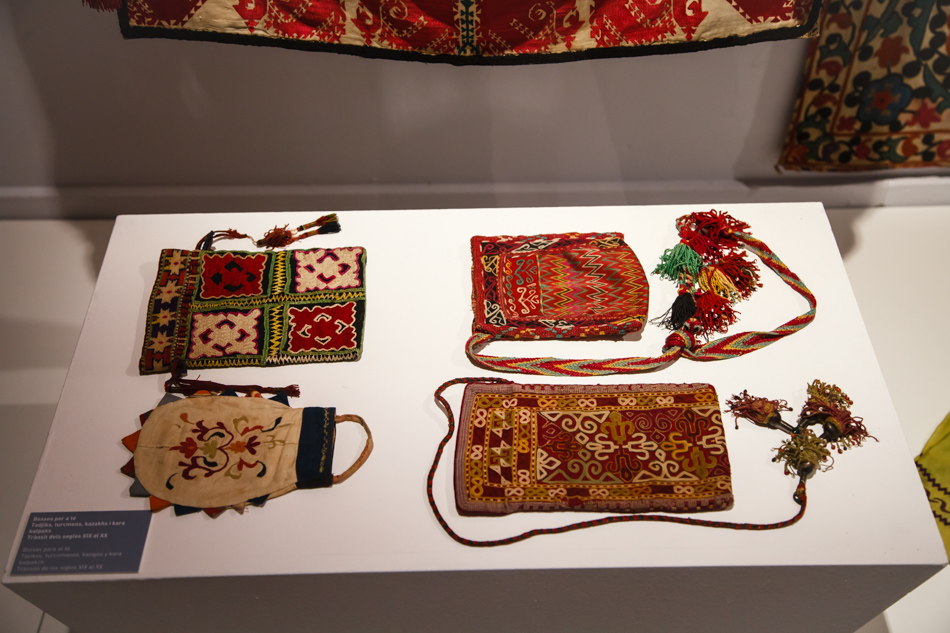
"The great silk road", exhibition at Museu Valenciá d'Etnologia 2011-12

Exhibit "La gran ruta de la seda. Caúcaso y Asia Central"
(The great silk road. Caucasus and Central Asia) 
Museu Valenciá d'Etnología, 14 December 2011 - 13 May 2012.

Exhibit of one of the great cultural icon of our civilization, but in this case it is dedicated
 to the areas of Caucasus and Central Asia, part of the actual Afganistán and Uzbekistan
 territories. These areas, despite the constant mention in the news due to war dramatic 
events, are quite unknown about their ethnic and cultural life. The exhibition propose
a travel to these peoples thru the process of silk production, dress and traditions,
makingof carpets, the life of nomads, architecture of yurts, rituals, etc.

The display contains objects, tools, carpets, mannequins wearing traditional
costumes, real life yurts, archival pictures, all dedicated to explain the life and 
history ofpeoples  who have been living in the those territories for generations.

Images of the exhibit.